Community Development
Engage residents and local stakeholders, document present-day needs, and develop a practical roadmap. Appropriate outreach, direct assistance, and modest pilot work may follow identified priorities.
 Donate
A program of The Poston Foundation
The Poston Preserve Initiative is The Poston Foundation’s place-based effort to strengthen the historic community of Poston in Florence County through public history, community development, preservation, and long-term planning.
Building stronger places together.
Preserving our shared legacy.
Enhancing spaces. Honoring Poston.
Planning today for tomorrow.
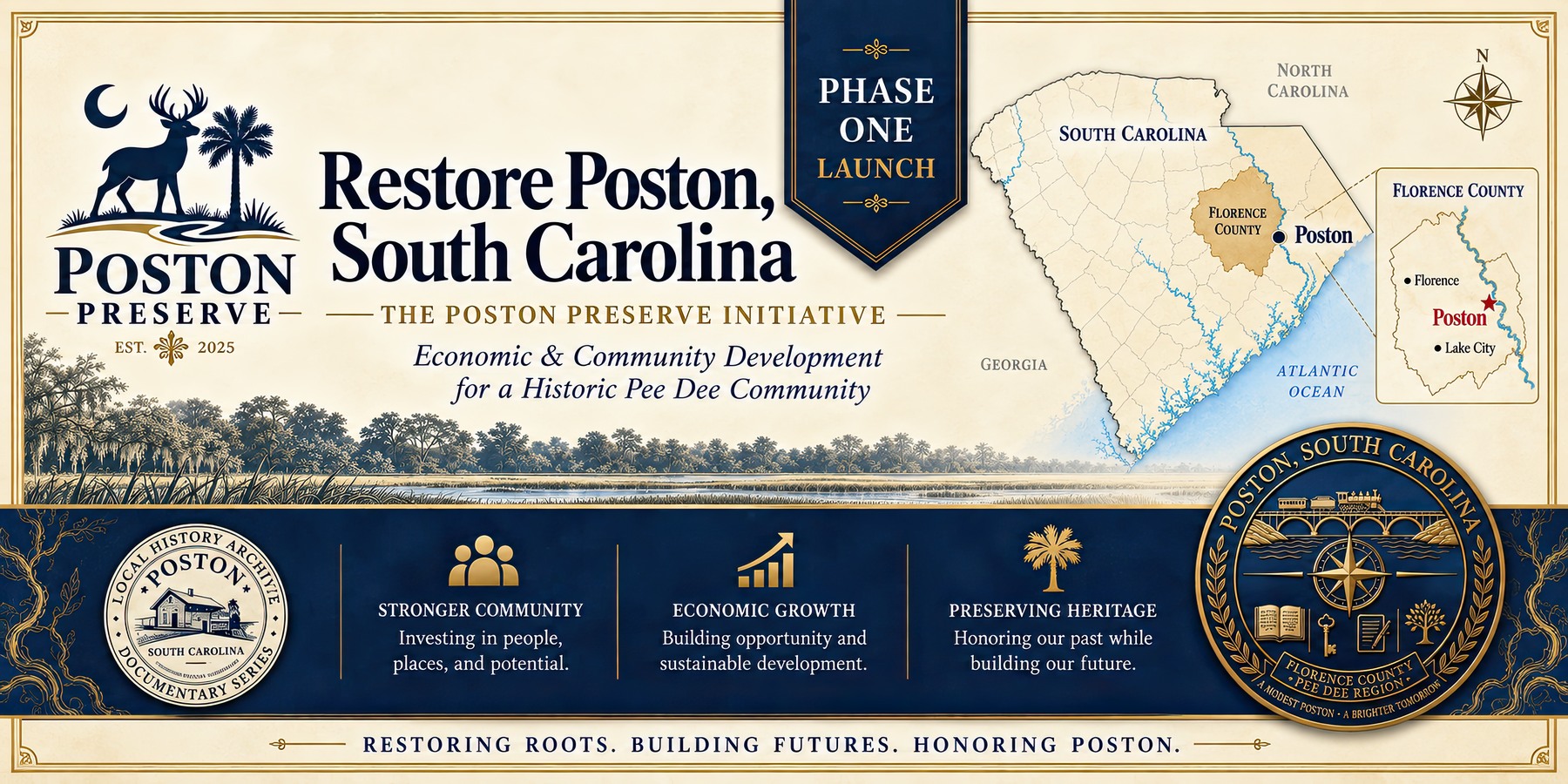
Restoring roots. Building futures. Honoring Poston.
A historic Pee Dee community
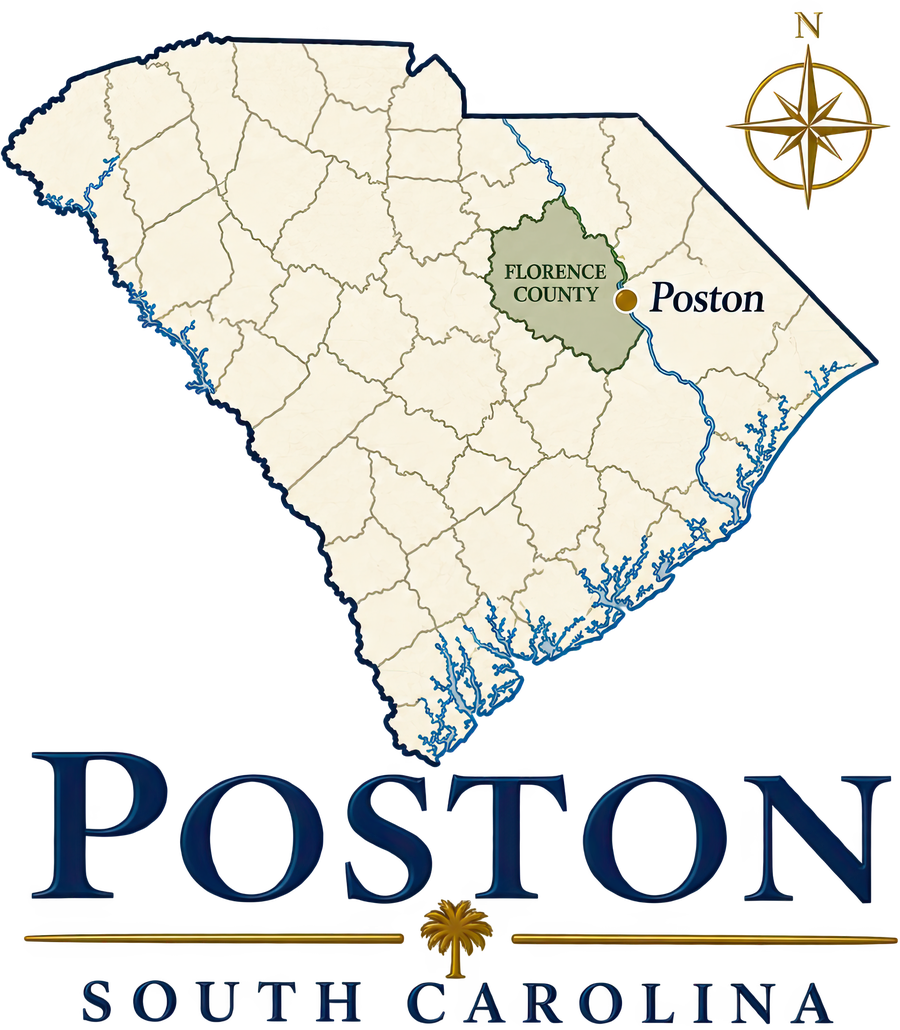
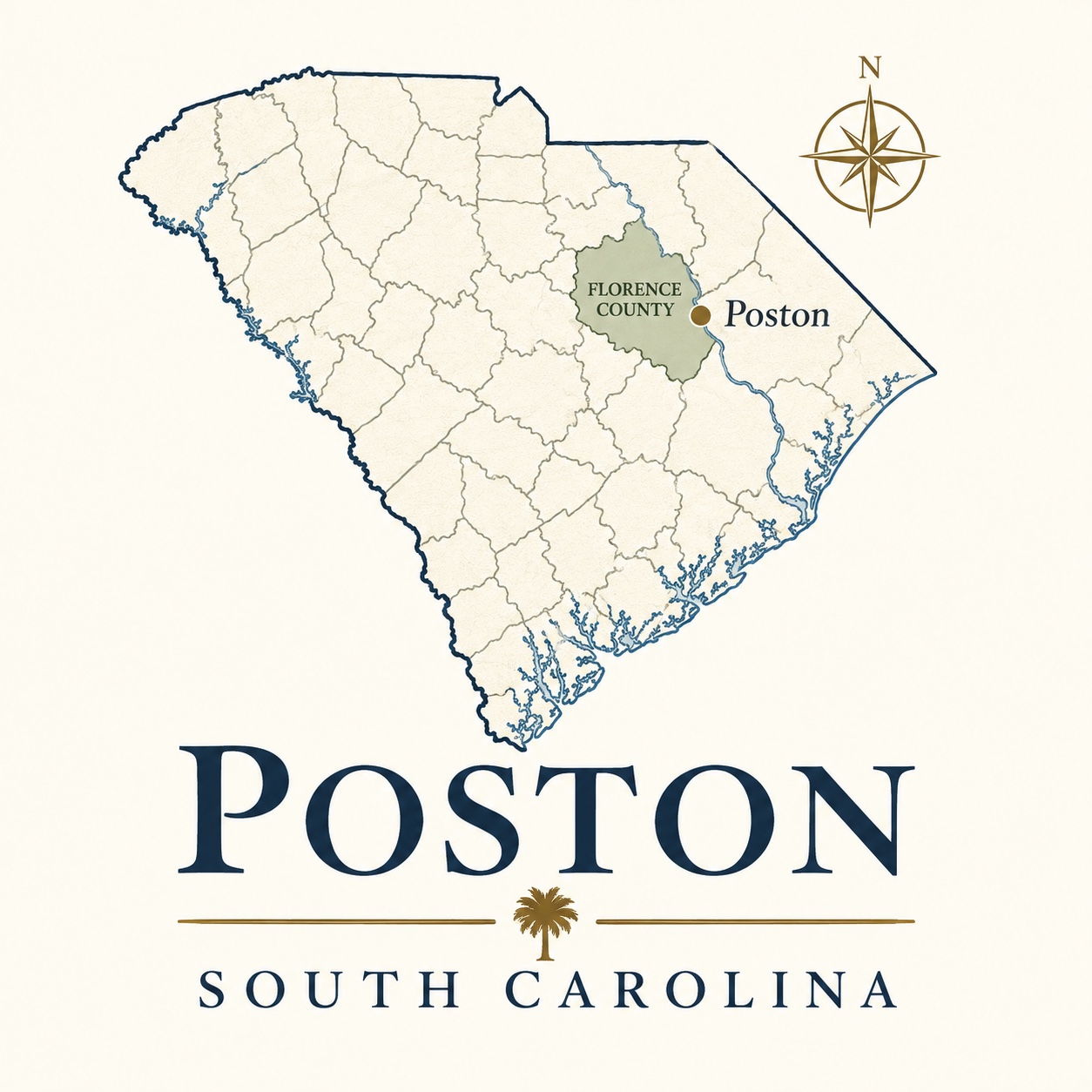
Poston is a historic unincorporated community in Florence County, in South Carolina’s Pee Dee region. Its identity connects local families, railroad history, and the landscape near the Great Pee Dee River.
The initiative begins here because there is a defined place, an existing documentary record, a family stewardship connection, and public archive infrastructure to build upon. That foundation supports careful research, community engagement, and practical planning for what comes next.
Across rural South Carolina, community records are often scattered among private collections, old newspapers, family research, church files and public archives. Photographs can lose their identifying details; cemetery information can become difficult to recover; and memories can disappear before they are recorded. At the same time, present-day residents may face needs that have never been gathered into a clear community profile.
The Poston Preserve Initiative brings those responsibilities together. Preserving public history creates a stronger record of the place. Listening to people connected to Poston helps identify practical priorities. The founding pilot is intended to build a disciplined model that can eventually inform work in other overlooked South Carolina communities, with local needs guiding each stage.
Launch support helps build the groundwork for larger grants, public partnerships and future projects: organized sources, an informed community profile, useful educational materials, partner relationships and a practical plan. It also supports preparation of sponsor and grant materials and donor updates that show what has been completed and what remains to be done.
Begin with the place
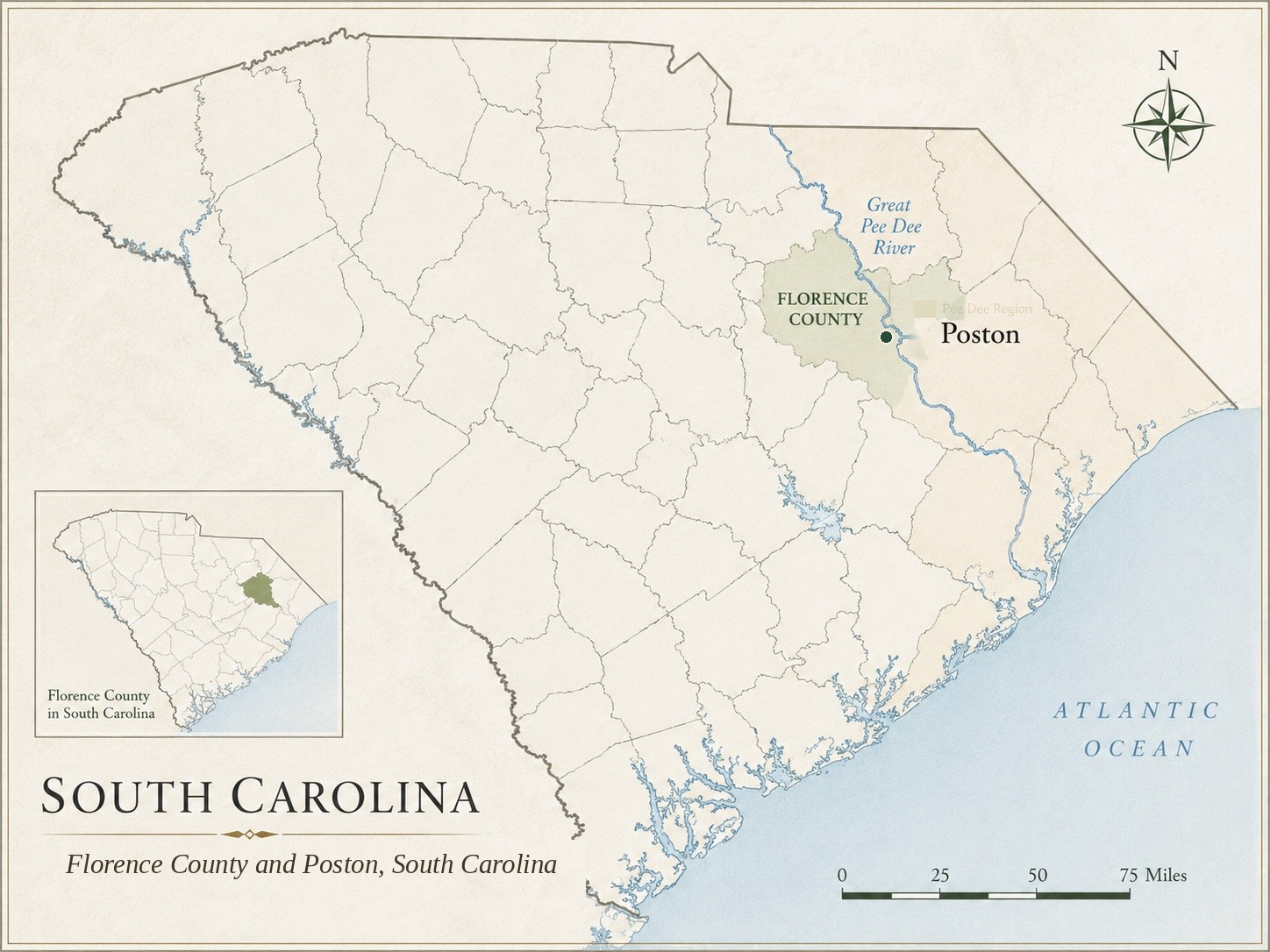
Located in Florence County near the Great Pee Dee River.
 View full map & geographic record
Map 1 of 3 · Poston locator
Select a thumbnail, use the arrow keys, or swipe to explore. Select the map to open its geographic record in a new tab, or choose “Enlarge this map” for a closer look here.
Preserve the record. Reconnect the community.
Build the groundwork for what comes next.
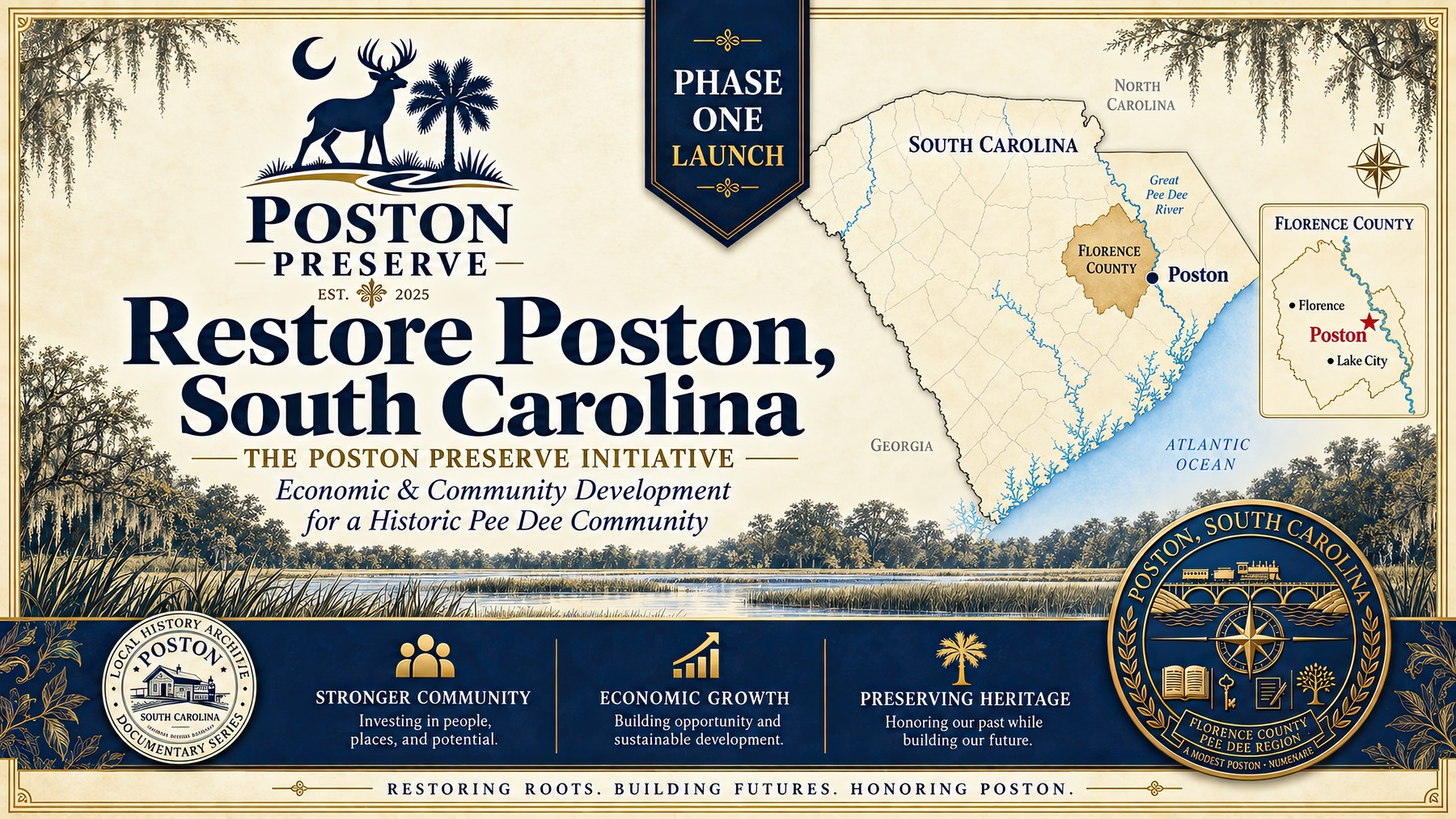
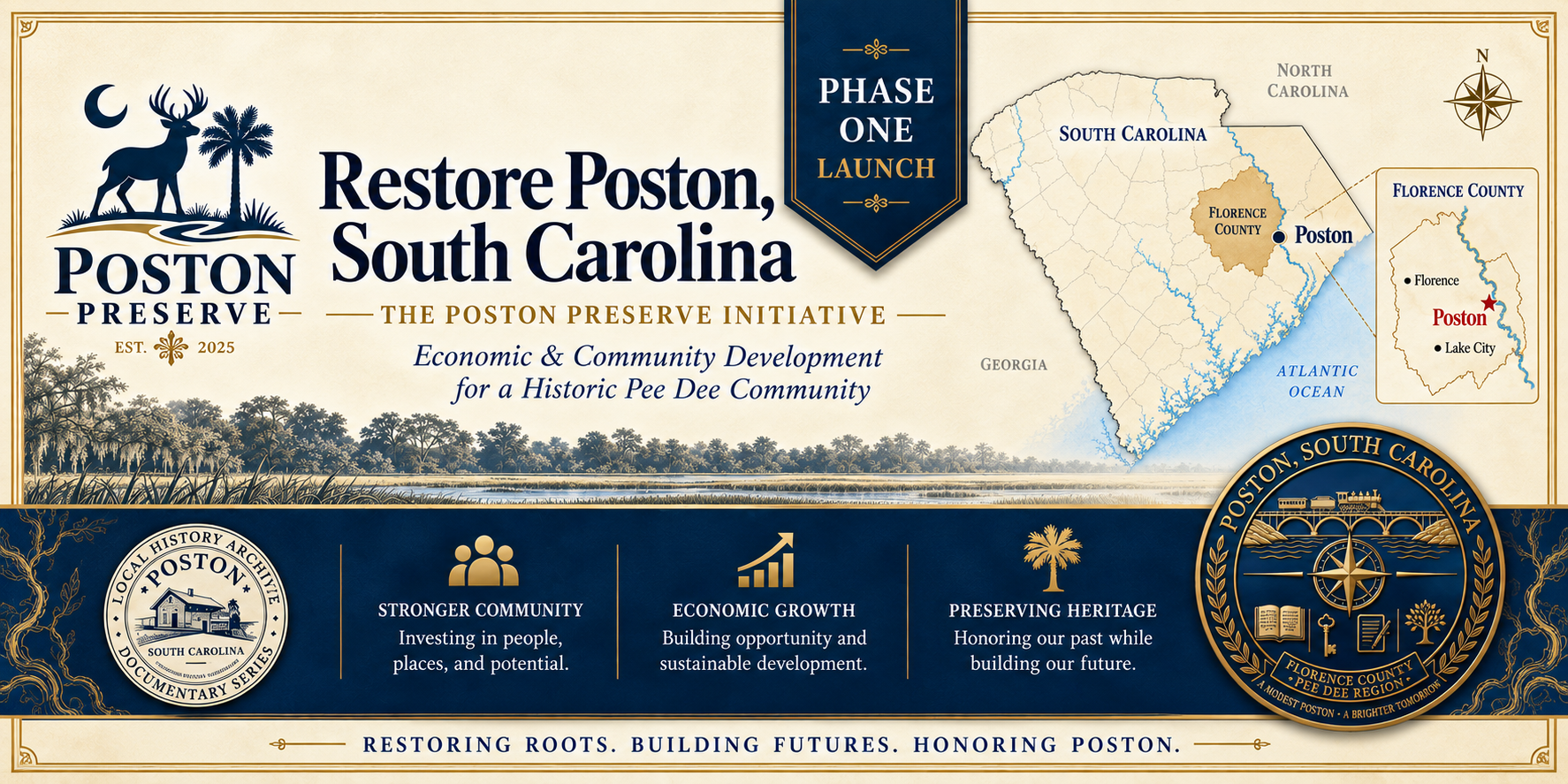
The current campaign funds the first stage of The Poston Preserve Initiative, beginning with the Restore Poston, South Carolina founding pilot. Phase One is designed to strengthen the historical record, organize the initiative, begin stakeholder outreach, identify practical community needs, develop partnerships, and launch modest visible work.
The broader initiative seeks to connect public-history preservation, education, practical community assistance, conservation planning, and long-term community development. Early work will help establish priorities and the capacity to pursue future support.
Engage residents and local stakeholders, document present-day needs, and develop a practical roadmap. Appropriate outreach, direct assistance, and modest pilot work may follow identified priorities.
Organize records, maps, photographs, source notes, and public archive materials. Prepare for oral-history work and educational resources that make Poston’s history more accessible.
See the existing public-history infrastructureIdentify feasible cleanup, signage-research, and community-pride projects with local input. Any visible pilot work will depend on available funds, permissions, and an appropriate charitable purpose.
Support early mapping, research, outreach, and potential partnerships in the lower Lynches and Great Pee Dee landscape. No land acquisition, easement, or watershed project is represented as secured.
What the launch makes possible
The proposed work connects preservation, education and practical community support. The archive supplies historical context; outreach establishes current priorities; and small, feasible projects turn that groundwork into public benefit.
Engage residents, property owners, descendants, churches, schools, local historians, public officials and potential partners. A community profile can bring together the area's geography, infrastructure, public assets, landmarks and service gaps.
Field visits, stakeholder conversations and a needs inventory will help identify which improvements are practical, who needs to be involved and what permissions or resources would be required. Community input is central to selecting a pilot.
Organize maps, photographs, newspaper sources, church and cemetery references, railroad materials and family records into accessible public resources. Work may include scanning, source notes, indexing, OCR cleanup and digital storage.
The existing Poston Archive and related research platforms provide a starting point. Launch support would improve how materials are described, connected and found, so residents, descendants, educators and researchers can use the record more easily.
Prepare to preserve the knowledge held by elders, former residents, descendants, landowners and community historians. Their recollections can help identify people in photographs, explain changes in the landscape and add context to church, cemetery and community records.
The proposed budget includes recording equipment, transcription and educational materials. Interviews and recordings would be arranged where appropriate; the planning assumptions do not represent interviews already completed.
Turn well-organized sources into useful handouts, research packets, bibliographies, source guides and accessible local-history materials. Potential applications include classroom resources, community presentations, student research, local-history events and public-history displays. Book stipends or other educational support may be considered where appropriate to the charitable program and available resources.
Educational publishing must serve the Foundation's charitable purpose. The emphasis is on preserving knowledge and helping people understand their community, with opportunities for younger generations to connect with the places and people that shaped them.
Identify a feasible community-support or beautification project with local input. Possible work includes a cleanup day, cemetery documentation or cleanup, signage research, volunteer service, public-history displays or another modest improvement.
Before physical work proceeds, the Foundation would need a defined scope, pricing, any required site permissions and sufficient funding. The launch goal includes a pilot allowance without promising a particular improvement in advance.
Needs-based support may include hygiene supplies, school supplies, seasonal items, resource information, referrals or Carolina Cares Essentials Kits for individuals and families connected to Poston.
Assistance is intended to remain modest, documented and responsive to demonstrated need, including opportunities to support young people, seniors and families. Its contents and delivery would follow outreach and local partnerships; the Preserve budget does not promise a fixed number of kits or recipients.
Explore how the lower Lynches and Great Pee Dee river corridor connects local history, natural resources and community stewardship. Early work may include mapping, research, technical consultation and conversations with potential partners.
This is an exploratory allocation. The proposed budget does not fund a land purchase, conservation easement or secured watershed project, and no such outcome is represented as already achieved.
Examine heritage-based development, local identity, rural placemaking, tourism potential, public access, small community events, signage and potential partnerships. Research can help determine which opportunities merit further investment.
Nonpartisan civic work may include boundary research, population and parcel review, service-feasibility questions, resident briefings and professional consultation. Any future incorporation effort would require resident-centered work and legal review; Phase One funds a roadmap for decisions.
The proposed use of launch support
The September 23, 2026 budget translates the campaign's activities into specific planning estimates. Allocations are proposed for review, subject to pricing, approval, available funds and any donor restrictions.
On a small screen, swipe the budget table sideways to view all four columns.
| Workstream | What it supports | Budget | Share |
|---|---|---|---|
| Community outreach & mapping | Resident engagement, community profile and practical needs assessment | $4,000 | 16% |
| Public archive & preservation | Source organization, digitization and public archive improvements | $5,000 | 20% |
| Oral history & education | Recording capacity, transcription and local-history materials | $2,500 | 10% |
| Visible community pilot | A modest project selected with local input | $5,000 | 20% |
| Direct assistance | Needs-based supplies, transport and resource information | $1,500 | 6% |
| Conservation planning | Early research, mapping and potential partnerships | $1,500 | 6% |
| Economic & civic planning | Professional consultation and a future-action roadmap | $3,000 | 12% |
| Coordination & reporting | Financial records, donor updates and processing allowance | $2,500 | 10% |
| Total proposed cash expenditure | $25,000 | 100% | |
The gross target includes a $750 donation-processing allowance. If used in full, $24,250 remains for the other listed costs. The 3% allowance is a planning reserve, not a quoted provider rate. No donated goods, volunteer time, matching funds or committed awards are assumed. Any current funding gap must be calculated from reconciled campaign receipts and confirmed commitments; the target alone does not establish how much remains to be raised.
The proposed allocation brings together $7,500 for archive and education, $10,500 for community outreach, the pilot and direct assistance, $4,500 for future planning, and $2,500 for coordination and reporting. Planning does not include land acquisition, an easement or a full municipal incorporation process. Coordination and reporting are specific expense allowances, not an approved indirect-cost rate.
These quantities, hours, rates and allowances are proposed costing inputs, not vendor quotes, approved commitments or promised output counts. Pricing and delivery dates need confirmation before funds are committed.
No employee salary or executive compensation is included in this proposed cash budget. Paid service work would require scoping and approval. Field-visit allowances are not mileage reimbursement rates, and underlying costs should be documented. The planning allowances should cover applicable tax and delivery costs.
From groundwork to documented progress
The delivery window is 12 months from an authorized start. These periods describe a planning sequence, not a calendar of confirmed events. Work will be paced to available funding, local input and permissions.
Months 1–3
Begin resident outreach, community mapping and archive organization. Obtain pricing and assess a feasible pilot.
Evidence to develop: an outreach log, initial community profile, source inventory and priced pilot scope.
Months 4–8
Continue archive and educational work. Undertake a locally informed pilot and appropriate direct assistance as funds and permissions allow.
Evidence to develop: organized materials, project records, purchase receipts and documented assistance.
Months 9–12
Complete the community profile and planning roadmap, document partners and assess next steps.
Evidence to develop: a public profile, roadmap, partner records, and a Phase One expenditure and progress report.
These are planned results. The Foundation intends to report actual activity against them. If support is limited, the budget narrative prioritizes archive and outreach work and calls for adjusting the pilot scope.
Support the Phase One launch
Help establish the research, relationships, and practical capacity that this work needs.
Your support may help fund:
Specific physical improvements depend on funding, local input, permissions, and review. Contributions support launch-stage charitable work.
Gifts of every size are welcome
These campaign giving levels illustrate how support can advance the charitable initiative. They are not prices for fixed outputs or promises that a particular amount will complete a project. Contact the Foundation to discuss a proposed designation or a defined sponsorship scope.
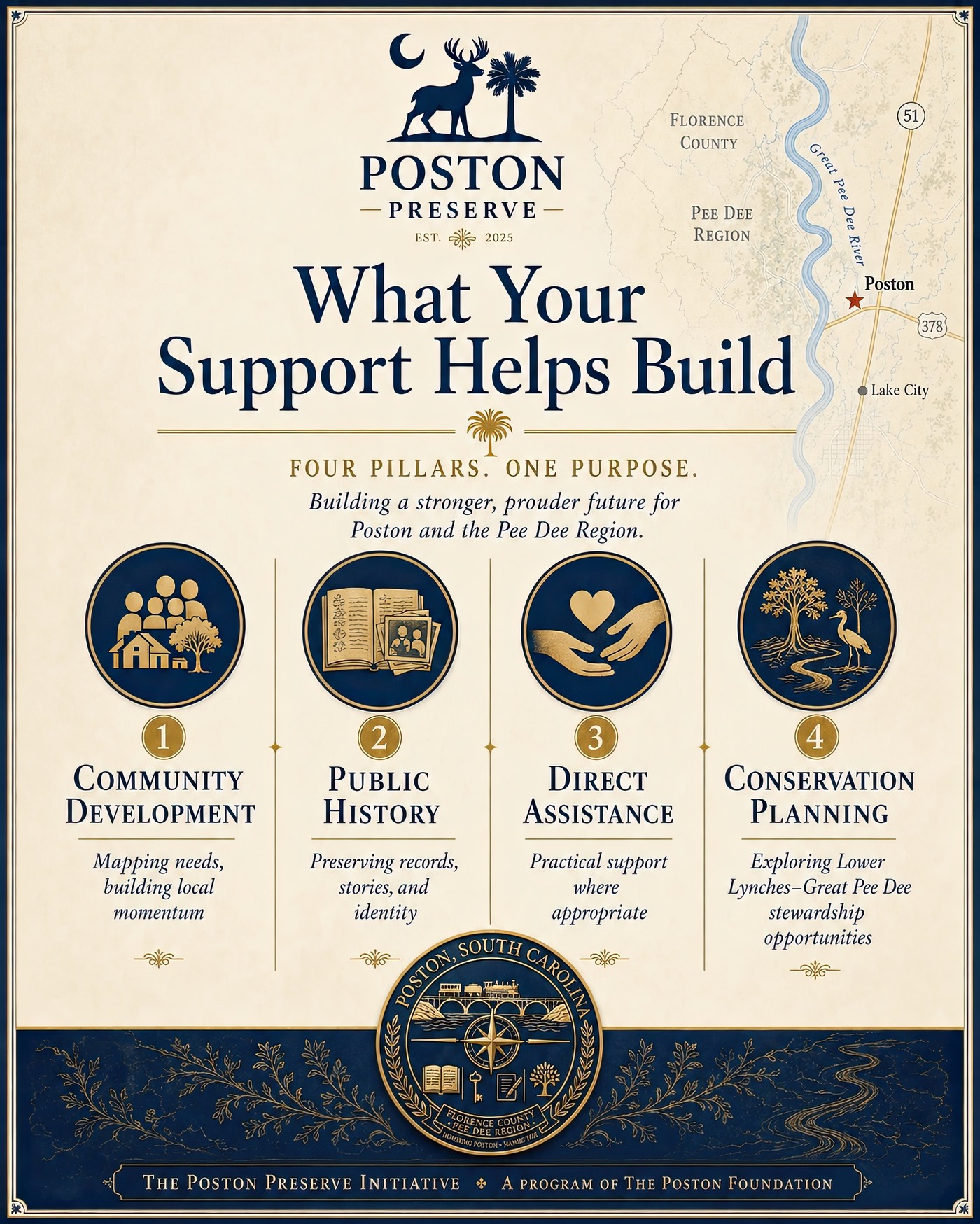
Phase One support can strengthen community outreach, public-history work, appropriate direct assistance, conservation planning, and the operating groundwork needed to report progress responsibly.
The campaign graphic groups these support uses for fundraising clarity; the page’s four program pillars remain the authoritative description of the initiative’s long-term framework.
$25
Helps support basic documentation, source organization, public-history materials and archive development.
$50
Helps preserve photographs, records, oral-history materials and local-history references before they are lost.
$100
Helps support educational materials, source notes, archive updates and public-facing historical documentation.
$250
Supports outreach, modest community-development work, beautification planning, direct-aid preparation or local-history materials.
$500
Supports archive expansion, educational materials, oral-history preparation, school support, cleanup supplies or pilot-project costs.
$1,000
Supports the founding pilot through archive development, outreach, appropriate direct assistance and planning for future support.
$2,500
Supports a defined launch-stage area of work such as archives, oral history, education, community assistance, beautification or conservation planning.
$5,000+
Provides major launch support for the founding pilot, archive infrastructure, community-development planning, donor reporting and future grant readiness.
Place, memory & the public record
Poston’s story connects the naming legacy of Andrew Poston, railroad-era development, and the Great Pee Dee River landscape in Florence County. Existing materials also trace an older river locality associated with Ellison, Allison Landing, Ellison’s Landing, and Poston Landing.
Maps, photographs, newspapers, genealogy, church and cemetery references, and local knowledge provide starting points for a fuller public record. Preserving those sources—and documenting where they came from—helps people understand the place and its community.
The initiative’s historical work is intended to bring these materials into a more accessible archive, support public education, and create room for residents and descendants to contribute their knowledge.
Share a source or discuss a partnershipArchive links open in a new tab.
Place History & Geography
Poston, South Carolina Historical Archive
Explore the documented history of Poston, South Carolina—from the older Ellison and Great Pee Dee River locality to railroad development, Andrew Poston, maps, landmarks, and the sources behind the community's name.
Genealogy & Documentary Records
The Poston Family Archive
Search digitized family and historical records connected to the Poston family of South Carolina and allied families, including newspaper pages, lineage materials, OCR transcriptions, photographs, historical records, and published research.
Residents, descendants & partners
The initiative needs local knowledge as well as financial support. People connected to Poston can help the Foundation understand the community's history, present-day needs and practical opportunities.
Photographs, maps, newspaper references, church and cemetery records, family papers and recollections may help fill gaps in the public record. Begin by describing the material, its connection to Poston and what you know about its origin.
Contact the Foundation to discuss a copy or scan and the context needed to preserve it responsibly.
Residents, property owners, churches, schools and local stakeholders can identify service gaps, overlooked assets and potential pilot projects. Information about access, ownership and local priorities helps establish which ideas are feasible.
Suggestions will inform planning; submitting an idea does not mean a project has been approved or funded.
Potential partners may be able to help with research, scanning, transcription, mapping, education, volunteer coordination, project supplies or professional consultation.
Discuss a useful scope before arranging a donation of goods or services. The proposed budget records in-kind support separately and calls for reducing affected cash needs where appropriate.
For Preserve funding, sources and partnerships, contact Eric Chalmers Poston, Executive Director, at eposton@thepostonfoundation.org or 803-365-3054.
Public purpose & stewardship
The Poston family story is the initiative’s origin and evidence base. Its public purpose is broader: preserve history, support education, strengthen community knowledge, and help address practical needs.
“Restore” means making Poston more visible, better documented, better supported, and better positioned for future decisions. It does not promise a particular governmental, development, or conservation outcome.
Campaign funds do not support private family benefit, private landholding expenses, unrelated commercial publishing, or private property improvements outside the Foundation’s charitable scope.
Any incorporation-related work would need to be resident-centered, legally reviewed, and consistent with applicable South Carolina law. No governmental outcome is guaranteed.
The Foundation intends to report on funds raised, records organized, outreach conducted, work completed, and next steps, distinguishing among the initiative’s workstreams.
The budget narrative calls for authorizing work within available cash, observing donor restrictions, obtaining pricing and site permissions, and recording approval before a commitment. Each expense would be assigned to a budget line to avoid duplicate charges.
The proposed approach includes monthly comparison of budget and actual costs, documentation of reallocations, and funder approval where required. Donor reporting is intended to distinguish archive progress, outreach, direct assistance, pilot activity and the use of funds.
The campaign in view
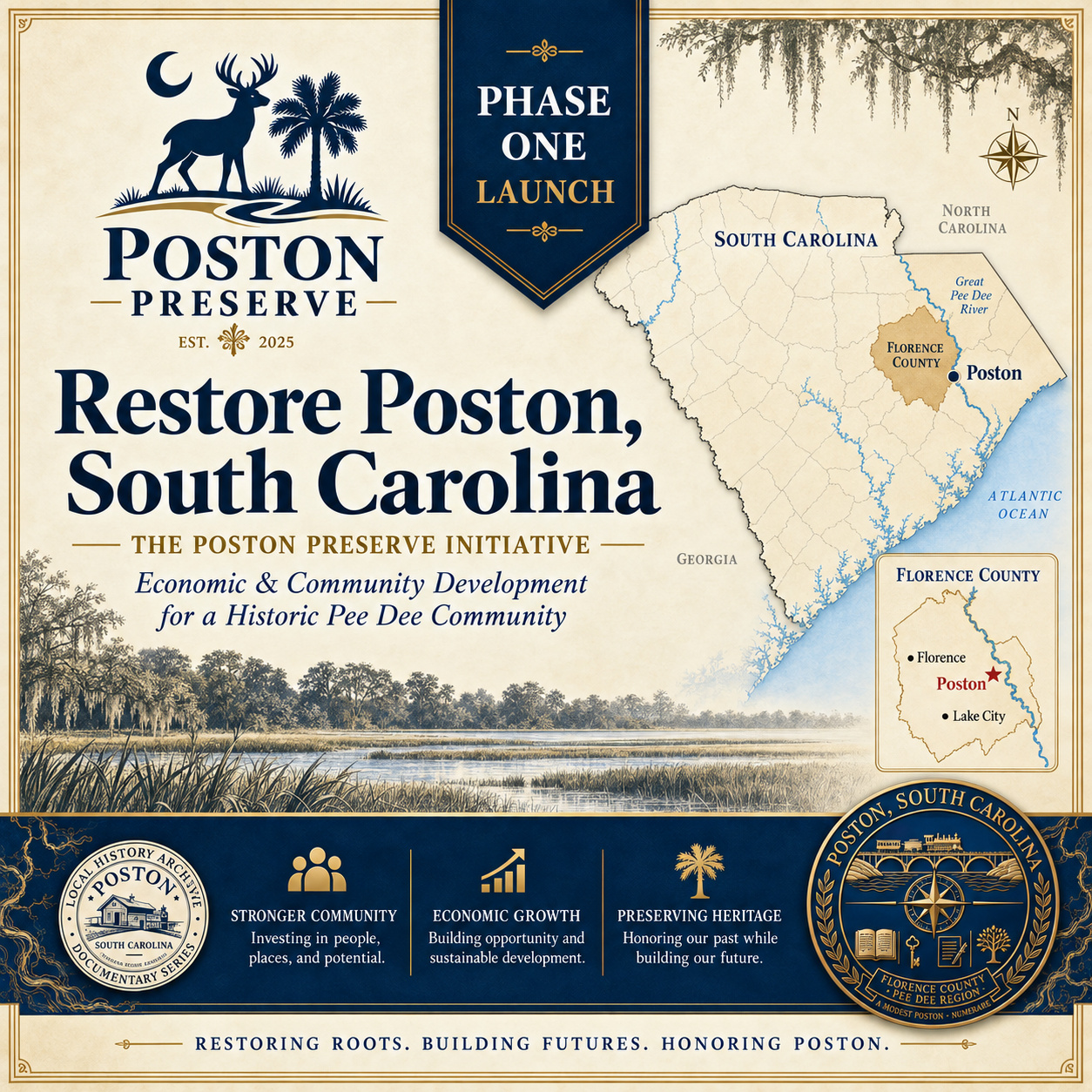
Review the campaign in detail
Read the launch brief for a concise overview, then use the budget and narrative to review the proposed allocations, cost assumptions, delivery sequence and reporting approach.
A one-page overview of the $25,000 launch goal, four core purposes, planned results and giving levels.
Open the funding brief (PDF) →A three-page proposed budget dated September 23, 2026, with eight categories, itemized estimates and a 12-month delivery framework.
Open the budget and narrative (PDF) →If the document does not display in your browser, open the funding brief directly.
For a sponsorship discussion or a grant-specific request, contact Eric Chalmers Poston, Executive Director, at eposton@thepostonfoundation.org or 803-365-3054.
The full documents distinguish proposed costs from confirmed commitments. For current funding status or a grant-specific budget, contact the Foundation. You can also read the full donation campaign and review Foundation transparency materials.
Frequently asked questions
No. This is a public charitable initiative of The Poston Foundation. The family history is the origin and evidence base, but the public purpose is broader: preserving history, supporting education, strengthening community capacity, and advancing practical projects connected to Poston and, over time, potentially similar South Carolina communities.
No. The Poston Preserve name may also be associated with a separate family landholding. This campaign supports The Poston Foundation’s charitable initiative, not private landholding expenses or private property improvements outside the charitable scope.
Poston provides a documented historical proof point, a family stewardship connection, existing archive infrastructure, a defined geography, and the first community-development focus. The larger model may later inform similar work in other overlooked South Carolina communities.
The Poston Preserve Initiative is supported by two complementary public research resources. PostonSouthCarolina.com is the place-history archive for Poston, South Carolina, including its Great Pee Dee River setting, older Ellison locality, railroad history, Andrew Poston, maps, landmarks, and source notes. The Poston Family Archive at PostonFamilyArchive.com preserves family and documentary materials, including digitized records, newspaper pages, OCR transcriptions, lineage materials, photographs, and historical publications. Together, these resources form part of the documentary foundation for the initiative's public-history work.
It means making Poston more visible, better documented, better supported, and better positioned for future investment. Phase One focuses on documentation, outreach, public history, needs assessment, direct assistance where appropriate, modest local projects, education, and planning.
The campaign may support nonpartisan civic-readiness research, community education, historical documentation, boundary research, and planning connected to Poston’s future. The Foundation is not claiming that any governmental outcome is guaranteed. Any future incorporation-related effort would need to be resident-centered, legally reviewed, and consistent with applicable South Carolina law.
The documented Phase One launch goal is $25,000. The proposed cash budget includes archive and educational work, community outreach, a modest pilot, appropriate direct assistance, early planning, coordination and reporting. It is a funding target, not a statement that $25,000 has been raised or remains unfunded. Any later expansion would need a separately defined scope and budget.
The Foundation intends to provide updates on funds raised, work completed, materials organized, outreach conducted, visible projects undertaken, and next steps. The objective is a disciplined and transparent launch process.
The budget proposes a 12-month window from an authorized start, with activity paced to available funds. It does not establish a confirmed start or end date. The Foundation will need to confirm dates, pricing and the final allocation before grant submission or spending commitments.
The Phase One materials do not claim a secured land acquisition, conservation easement or watershed project. Conservation work is exploratory planning. Physical improvements require local input, appropriate permissions, an approved scope and sufficient funding.
Where outreach identifies a need, Carolina Cares Essentials Kits or other appropriate supplies may form part of the Preserve's modest direct-assistance work for people connected to Poston. The proposed Preserve budget includes $1,500 for assistance supplies, transport and resource information; it does not promise a set number of kits or recipients.
No. The September 23, 2026 allocations, rates, hours and allowances are proposed planning inputs for review. They need pricing and approval before commitments. No employee salary or executive compensation is included, and any paid service work would require a defined scope and approval.
The budget narrative calls for phasing archive and outreach work first and adjusting the pilot scope to available resources. Changes should be documented, donor restrictions observed and funder approval obtained where required. In-kind support would be recorded separately and could reduce relevant cash needs.
Yes. Residents, descendants and partners can share information about historical sources, community needs and potential projects, or discuss research, scanning, transcription, mapping, volunteer help, supplies and professional skills. Contact the Foundation to identify a useful scope and the information needed before sharing materials or arranging support.
Restore Poston, South Carolina
Preserve the record. Strengthen the connections. Support the groundwork.