Money In, Supplies Out
Track contributions, approved purchases, in-kind products, inventory, and kit-preparation activity.
 Donate
Impact
Impact reporting starts with records, not adjectives.
The Foundation’s standard is straightforward: distinguish plans from completed work, keep records that support public claims, and report actual activity in terms people can understand.
Our Public Profile
Carolina Cares has a documented history of direct outreach in Columbia dating to 2020, including authentic field video and third-party news coverage. The renewed 2026 program plan adds clearer budgets, standardized or semi-standardized Essentials Kits, stronger controls, and a defined reporting framework.
South Carolina nonprofit
IRS-recognized public charity
South Carolina
Carolina Cares & Poston Preserve
Public identifier
What we track now
Track contributions, approved purchases, in-kind products, inventory, and kit-preparation activity.
Count kits assembled and distributed, record distribution activity, and preserve the documentation needed to explain what occurred.
Track volunteers, sponsors, businesses, in-kind contributors, and community partners when their participation can be documented appropriately.
Compare plans with actual results, note changes in cost or operations, and explain what should be improved before the next cycle.
How Impact Should Be Measured
Kits prepared, supplies purchased, distributions completed, and practical support delivered—when documented and ready for public reporting.
Sponsors, in-kind contributors, volunteers, and community relationships supporting charitable operations.
Documented expenditures, internal controls, donor tracking, public updates, and realistic claims aligned with current capacity.
Documented History
Original Carolina Cares field videos, photographs, and WACH FOX 57 coverage show direct outreach as it happened during the first months of COVID-19 in Columbia. We preserve that material as history—not as a substitute for current-year reporting.
Explore the Carolina Cares archiveRead the Numbers in Context
The current public materials provide program plans and a historical record. The figures below explain their status so a planning assumption is not mistaken for delivered aid.
| Figure or record | Status | How to interpret it |
|---|---|---|
| Carolina Cares outreach in 2020 | Historical activity | Field videos and news coverage document early outreach in Columbia. This record does not establish a current-year kit total. |
| 1,000 kits shown for 2025 in Candid | Historical target | The accompanying Candid note explicitly describes a distribution goal. It is not a verified count of completed distributions. |
| $5,000 and approximately 200 kits | Carolina Cares launch framework | The smaller initial distribution plan in the launch funding brief. Kit quantity is an estimate that depends on pricing, in-kind support, and responsible sourcing. |
| $30,000 and approximately 1,000 kits | Carolina Cares twelve-month plan | A funding framework and planning target, dependent on resources, costs, and delivery capacity. |
| $25,000 for Poston Preserve Phase One | Proposed launch budget | Planning allocations for public charitable work; not evidence of funds received, approved commitments, or completed projects. |
Current-year cumulative fundraising receipts and verified distribution totals are not presented here. Ask the Foundation for the latest available reconciled information when making a funding decision.
Carolina Cares
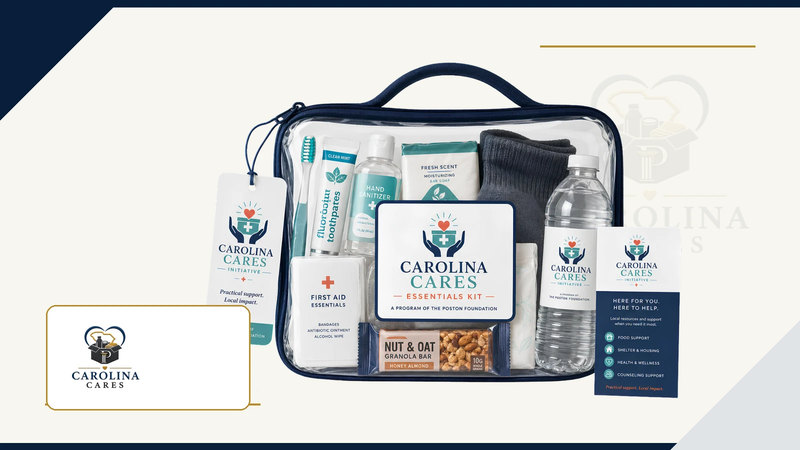
A meaningful update connects funds received and appropriate donated goods to supplies purchased and kits assembled. Useful records include contribution dates and restrictions, purchase receipts, supply categories, and kit-preparation counts.
The current plan assumes an estimated average of $25 in direct supplies per kit. The full $30,000 framework also includes distribution and administrative support. Actual costs and kit contents may change with sourcing, season, need, and available funding.
Distribution records can identify dates, a location or partner, and the number of kits provided without unnecessary recipient details. Reporting should explain the difference between kits assembled and kits actually distributed.
Feedback about usefulness, missing items, seasonal needs, or distribution arrangements can help improve the next cycle. A kit count measures a tangible program output; it does not by itself measure a lasting change in housing, employment, or health.
The $5,000 launch brief describes an initial distribution effort. The $30,000 stewardship plan describes a twelve-month program. Those scopes have different cost assumptions: the launch brief uses an approximate all-in allowance, while the annual framework separates direct supplies from distribution and administrative costs. Final kit counts should follow actual purchasing and distribution records.
Read the stewardship and program plan (PDF) · Explore Carolina Cares
Poston Preserve
The launch plan combines community knowledge, historical records, and practical preparation for local action. Progress should be visible in the materials and work completed.
Planned work includes resident and property-owner outreach, community mapping, and assessment of practical needs. A public community profile and outreach records would help explain what was learned and how it informed project choices.
The plan calls for organizing source material, expanding the Poston Archive, and preparing oral-history and educational work. Progress can be described through accessible materials, organized records, and documented preservation activity.
At least one modest community project is a planned Phase One result, subject to local input, funding, feasibility, and permissions. Public reporting should identify the selected scope, spending, and completed work rather than assume a particular improvement in advance.
The proposed sequence concludes with a community profile, an economic and incorporation-readiness roadmap, partner records, and a Phase One progress and expenditure report. Conservation and civic research remain planning activities; no governmental or conservation outcome is assumed.
Review the proposed budget and delivery sequence (PDF) · Explore Poston Preserve
Learning and Accountability
Share what was useful, where a resource gap remains, or what could work better in a future distribution or community project. The Foundation’s Candid disclosures describe using feedback to improve programs, understand needs, and strengthen relationships.
For Poston Preserve, local knowledge can help identify records, clarify community history, or inform a feasible project. Contact the Foundation before sending original records or materials requiring special handling.
Ask which figures are plans, which represent received support, and which are backed by completed activity. A clear report should state its period, explain material changes, and connect spending to the work it describes.
The public document library provides the current program frameworks. For a recent update, a grant reporting requirement, or a question about a published number, contact The Poston Foundation.
The strongest impact claim is one the organization can document, explain, and stand behind.”
— The Poston Foundation